Lalitpur — The historic Nrisimha Jatra, which has been held since the reign of Malla King Siddhi Narasimha Malla of Lalitpur, has concluded. The Jatra, traditionally observed in Patan every year on the fifth day of the waning moon in the month of Bhadra, concluded this year on Tuesday. The festival is celebrated with prayers for protection from natural and divine calamities and for peace to prevail throughout the world.
The Razopadhyay community, belonging to six lineages of Lalitpur, has traditionally taken turns to organize the Jatra based on seniority in age. This year, the family of Bhupati Rajananda Razopadhyay of Agnishala Woleemha was responsible for organizing the festival.
The Jatra commemorates the mythological event in which Lord Vishnu assumed the form of Nrisimha, the half-man, half-lion incarnation, and killed the demon king Hiranyakashipu. During the festival, the image or representation of Narasimha is taken around the ancient city of Lalitpur accompanied by traditional musical instruments and devotional singing groups.
One of the distinctive traditions of the Jatra is that devotees walk backward while facing Narasimha, holding incense in their hands and offering prayers. This ritual is associated with the devotion of Prahlada, the son of Hiranyakashipu and a great devotee of Lord Vishnu.
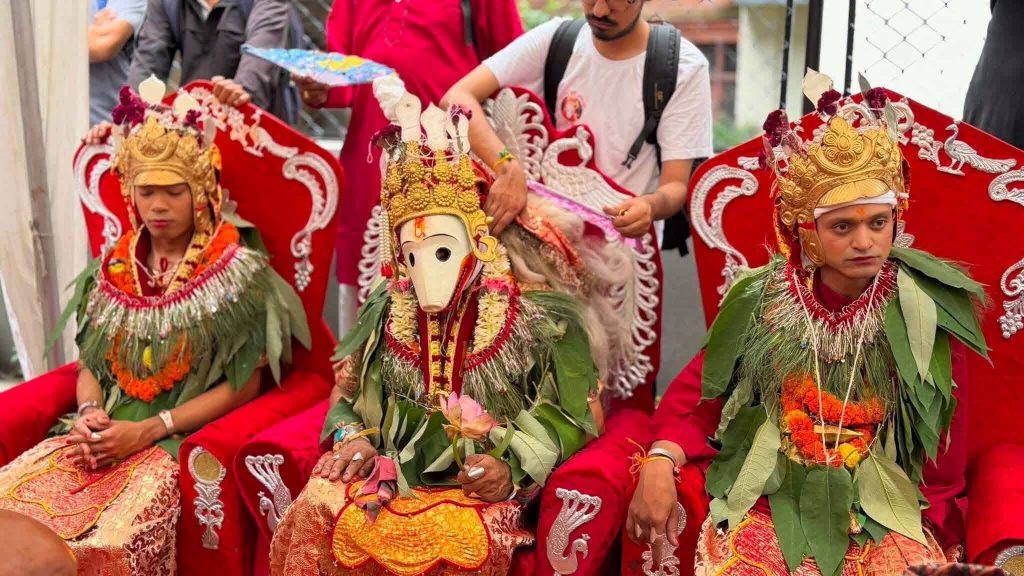
Lakshmi and Saraswati are traditionally positioned on either side of Nrisimha, while six pairs of young girls also participate in the procession. According to tradition, a priest, son-in-law, or maternal nephew from the family responsible for that year’s Jatra takes on the form of Narasimha and leads the procession along the traditional Saya, or Saparū route, through the ancient city of Lalitpur.
During the Jatra, the procession of Nrisimha and the accompanying deities travels through various historic neighborhoods of Patan, including Gabahal, Pimbahal, Bangalamukhi, Kobahal, Mangal Bazaar, Sundhara, Ikubahal, Mahaboudha, Tangal, Tichhu Galli, Haugah, Ikhalakhu, and Purnachandi, accompanied by traditional music and live devotional performances.
At various points along the route, ritual ceremonies and worship are performed for Nrisimha and the other deities. There is also a distinctive tradition in which Nrisimha drags a cloth effigy behind him during the procession. Children are made to bow before the cloth effigy, a practice believed to bring them protection, well-being, and good fortune.
Lalitpur is believed to have two distinct forms of Nrisimha. The Nrisimha portrayed during the Kartik Naach is regarded as the fierce form, while the Nrisimha of the Upalakan Saya is considered to be a calm and peaceful manifestation.
According to historical documents, the Nrisimha Jatra has been conducted since Nepal Sambat 751, corresponding to Bikram Sambat 1688. With its deep religious and cultural significance, the Jatra continues to be one of Lalitpur’s important living cultural traditions and heritage practices.